
Soft-sealed butterfly valves are widely used in water supply and drainage, HVAC, water treatment, fire protection, and industrial piping systems due to their excellent sealing performance, ease of operation, and moderate cost. To ensure reliable sealing performance and a long service life for every valve, the production process involves rigorous manufacturing and inspection procedures.
Step 1: Raw Material Procurement and Preparation
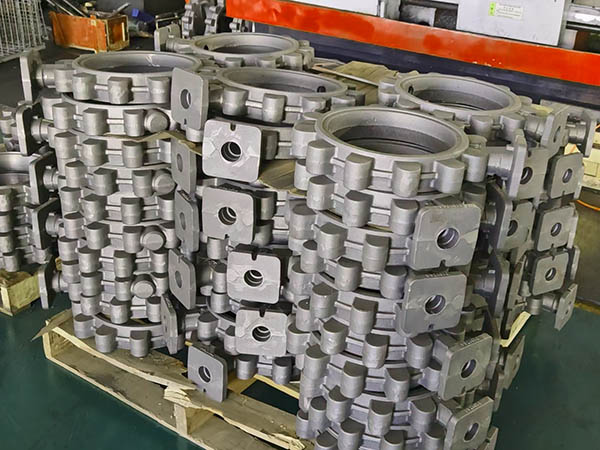
Raw materials required for the production of soft-sealed butterfly valves are procured in accordance with customer orders, design drawings, and technical standards.
Key materials include:
* Valve body materials: Ductile iron (GGG40, GGG50), WCB/LCB/LCC, stainless steel, etc.;
* Valve disc materials: Ductile iron, CF8, CF8M, 2205 duplex stainless steel, etc.;
* Valve stem materials: SS410, SS420, SS431, 17-4PH stainless steel, etc.;
* Valve seat materials: Rubber or polymer materials such as EPDM, NBR, PTFE, FKM, etc.;
* Auxiliary components: Fasteners, pins, bushings, etc.
All materials must comply with relevant international standards and customer requirements.
Step 2: Raw Material Inspection
Upon arrival at the factory, raw materials undergo comprehensive inspection by the quality control department to ensure they meet production requirements. Inspection items primarily include:
2.1 Chemical composition analysis;
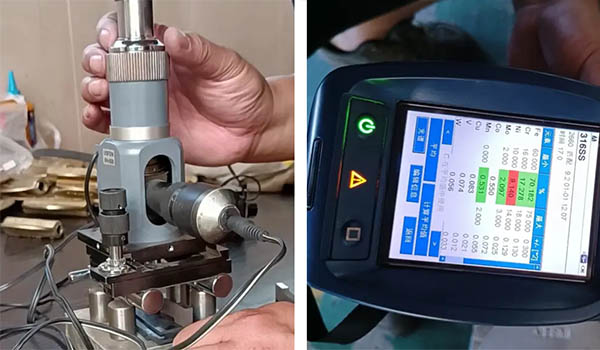
* Metallurgical microscope analysis of nodularity in ductile iron:
Grade | Nodularity
Grade 1 | ≥90%
Grade 2 | 80–90%
Grade 3 | 70–80%
Grade 4 | 60–70%
Grade 5 | <60%
* Spectrometer analysis:
Carbon content
Chromium content
Nickel content
Molybdenum content
Sulfur and phosphorus content
Ensure the material grade matches the material certificate provided by the supplier.
2.2 Dimensional inspection;
Rough casting/forging dimensions do not require excessive precision, as subsequent assembly-line processing involves rigorous, multi-stage inspections. Dimensions must be compared against drawings and allowances maintained (i.e., dimensions must not fall below the minimum machining allowance).
* Valve body:
Flange outer diameter/wall thickness
Face-to-face dimension (structural length)
Valve body height
Top flange thickness
Flow passage inner diameter
* Valve disc:
Outer diameter
Center thickness/edge thickness
* Valve stem:
Diameter
Length
* Valve seat:
Outer diameter
Inner diameter
2.3 Visual inspection;
Key checks: Inspect the valve body and disc for cracks, porosity, slag inclusions, etc.; inspect the seat for indentations or material defects (missing material).
2.4 Review of material certification documents.
Material certificates usually accompany the shipment, detailing chemical composition, physical properties, and traceability numbers such as heat numbers.
Step 3: Component machining and manufacturing
Raw materials that pass inspection proceed to the CNC machining workshop.
3.1 Valve body machining
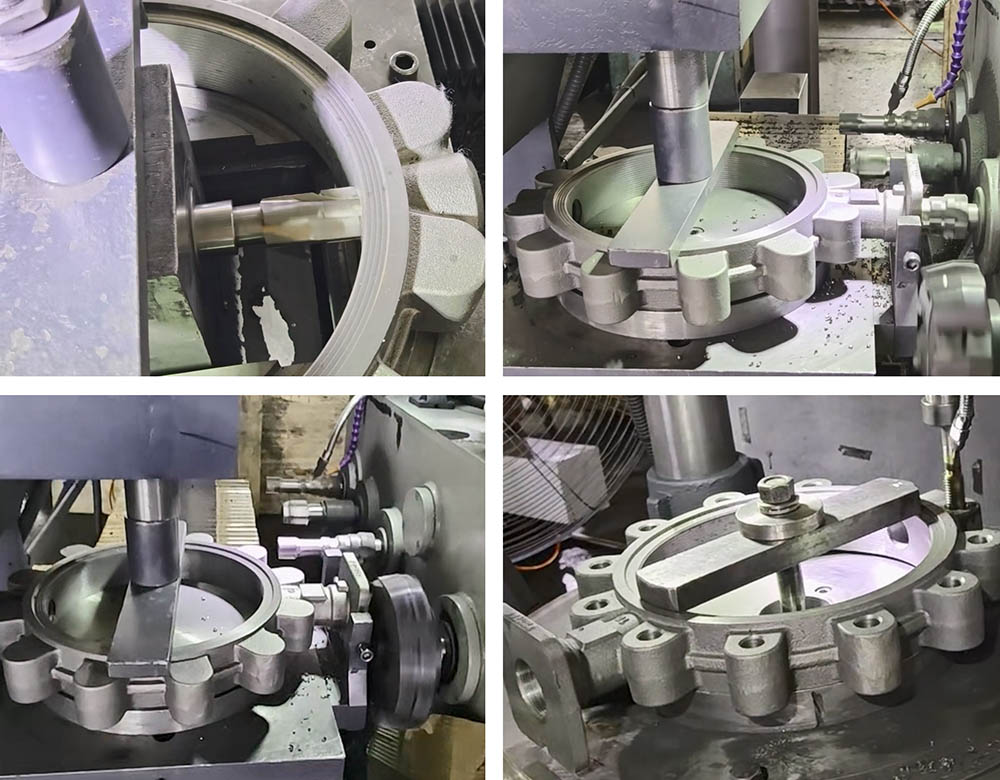
The valve body requires the following processes:
* Flange face machining;
* Sealing surface machining;
* Shaft bore machining;
* Top flange machining;
* Drilling, tapping, etc.
Key control parameters:
Coaxiality
Flatness
Hole position accuracy
Ensure installation dimensions comply with standards such as ISO 5211, EN 593, and API 609.
3.2 Valve disc machining
* Sealing edge (outer circumference) machining;
* Stem connection hole machining.
Ensure effective sealing contact between the valve disc and the valve seat. 3.3 Valve Stem Machining
* Keyway machining;
* End machining;
* Polishing.
These steps are performed to enhance wear resistance and assembly precision.
3.4 Valve Seat Manufacturing
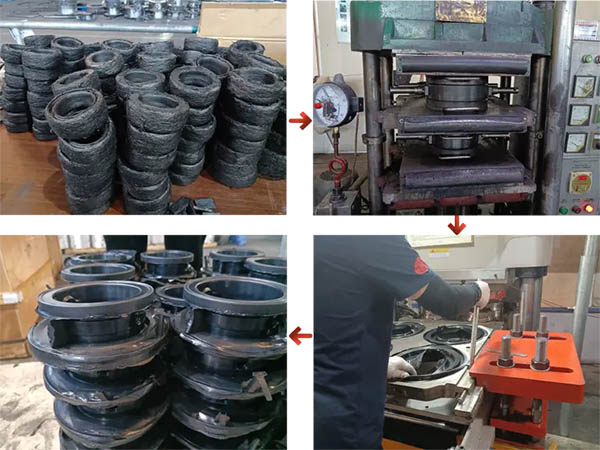
This is the most critical component of a soft-seated butterfly valve. Whether producing a replaceable soft seat, a hard-backed seat, or a vulcanized seat,
the first step is always to mix rubber according to a specific formula to create the base rubber compound.
Typically, primary materials such as natural rubber and carbon black are added in specific proportions, along with various additives.
Different formulas determine:
Temperature resistance
Corrosion resistance
Compression set
The second step involves machine-pressing the compound into rubber sheets and testing the material properties, as well as determining the optimal molding temperature and time.
In the final step, following mechanical stretching, the material undergoes:
* Compression molding—for replaceable soft seats;
* Vulcanization—for vulcanized seats;
* Rubber-to-metal bonding—for hard-backed seats;
This ensures precise seat dimensions, uniform elasticity, and stable sealing performance.
Step 4: Precision Dimensional Measurement
After undergoing successive machining operations, the precise dimensions of the component need to be measured here.
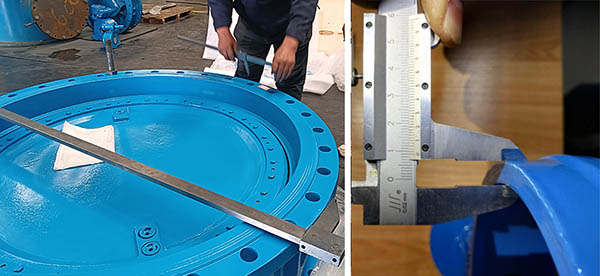
* Valve Body:
Flange outer diameter/wall thickness
Flange hole diameter, PCD
Face-to-face dimension (structural length)
Valve body height
Top flange thickness, diameter, hole diameter, PCD
Flow passage inner diameter
* Valve Disc:
Outer diameter
Center thickness
Edge thickness
Flatness
* Valve Stem:
Diameter
Length
Keyway dimensions
Straightness
* Valve Seat:
Outer diameter
Inner diameter
Step 5: Surface Treatment and Anti-Corrosion Coating
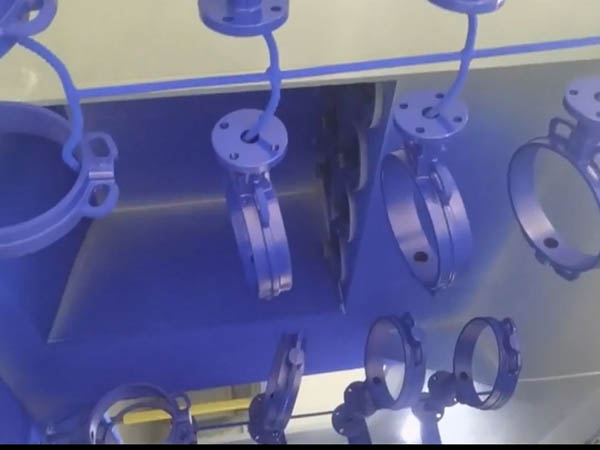
After machining, metal components undergo surface treatment.
Common processes include:
* Sandblasting: Using high-speed steel grit to remove scale, rust, oil, and contaminants;
* Pickling and passivation (stainless steel components only);
* Electropolishing (stainless steel components only).
Valve body surfaces are typically finished with epoxy resin powder coating.
The coating thickness generally exceeds 250 μm, effectively enhancing the product's corrosion resistance, service life, and aesthetic appeal.
Special anti-corrosion coatings may be applied for seawater, chemical processing, or highly corrosive environments. Step 6: Butterfly Valve Assembly
After machining and inspection, all components are transferred to the final assembly workshop.
Step 6: Assembly of Butterfly Valve
The assembly process primarily includes:
①. Installing the valve seat;
②. Installing the valve stem bushings;
③. Installing the valve disc;
④. Adjusting the centering of the valve disc;
⑤. Installing the upper and lower valve stems;
⑥. Installing pins or connection mechanisms;
⑦. Installing the handle, worm gear box, pneumatic actuator, or electric actuator;
⑧. Adjusting the opening/closing travel limits.
Strict control of coaxiality and mating clearances is required during assembly to ensure smooth operation and reliable sealing.
Step 7: Inspection and Quality Control
An intermediate inspection is conducted after assembly.
Key inspection items include:
* Valve appearance quality: coating, logo, etc.;
* Product dimensions: flange connection dimensions, top flange dimensions;
* Opening/closing angle: verifying if the valve disc is in the correct position when the actuator is fully open or closed;
* Operating torque: using a torque wrench to verify the torque is within the acceptable range;
* Component assembly status.
Quality control personnel verify each item against inspection standards to ensure the product meets design requirements.
Step 8: Pressure and Performance Testing
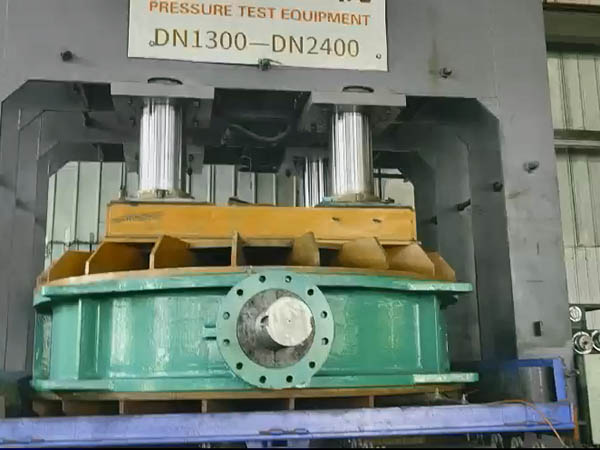
Every soft seat butterfly valve undergoes rigorous testing before leaving the factory, typically in accordance with API 598 or EN 12266 standards.
8.1 Shell Strength Test
Applying a specified pressure—usually 1.5 times the working pressure—to the interior of the valve body to verify body strength and structural integrity.
8.2 Sealing Test
Typically conducted at 1.1 times the working pressure to check for leakage when the valve is in the closed position.
Test media typically include:
* Clean water;
* Compressed air;
* Nitrogen (for special requirements).
Soft-seated butterfly valves are generally required to meet zero-leakage standards.
Cycle life testing and high/low-temperature testing may also be performed if necessary.
Step 9: Packaging and Shipment
After passing tests, the product proceeds to final packaging.
Pre-packaging steps include:
* Product cleaning;
* Nameplate installation;
* Inclusion of the certificate of conformity;
* Archiving of inspection records. Packaging methods are selected based on transportation requirements:
* Bubble wrap for dust and impact protection;
* Cardboard separators;
* Plywood crates;
*Note: Foam packaging may also be used when necessary.*
Finally, the warehousing department arranges container loading and shipment to ensure the products are safely delivered to the customer's site.
Summary
The manufacturing of soft-seated butterfly valves involves far more than simple component assembly; it encompasses multiple stages, including material control, precision machining, rubber molding, surface treatment, assembly and commissioning, and rigorous testing. Only through comprehensive production management and quality control systems can we ensure that every soft-seated butterfly valve operates reliably and stably over the long term across various industrial piping systems.