
Among various connection types, lug-type butterfly valves are widely used due to their flexible installation and ease of maintenance. Previous articles have emphasized that, compared to wafer-type butterfly valves, lug-type butterfly valves can also be used as end-of-line valves.
So, are all lug-type butterfly valves suitable for end-of-line applications?
The answer is: not all lug-type butterfly valves are suitable for end-of-line applications. Only rigid-backed lug-type butterfly valves are suitable.
And pressure ratings, etc., must be considered.
This article will explain in detail why rigid-backed lug-type butterfly valves are suitable for end-of-line applications.
1. What is End-of-Line Service?
End-of-line service refers to a valve installed at the end of a pipeline, with one side bearing the pressure of the medium, and the other side in an open state or not connected to a downstream pipeline.
2.Hard-backed vs. replaceable-seat Lug Butterfly Valve?
Because the outer of a lug-type butterfly valve has threaded lugs, it can be directly connected to a pipe flange using a screw. Therefore, it's impossible to determine from the valve body whether all lug-type butterfly valves can be used for dead-end service.
So, what's the key? Actually, it depends solely on whether the valve seat can be fixed to the valve body.
Currently, there are two common ways the lug-type butterfly valve seat and valve body are connected: Hard-backed butterfly valves and flexible-seat butterfly valves.
2.1 Hard-Backed Seat
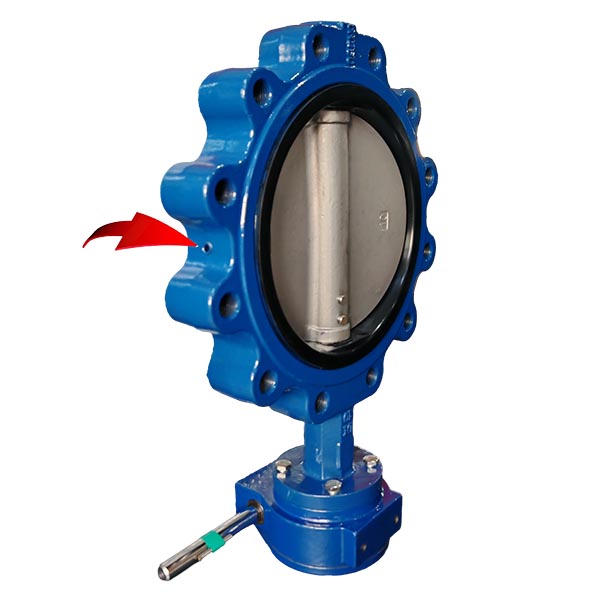
The material of a Hard-backed valve seat: The body is mostly made of phenolic resin, aluminum alloy, carbon steel, or stainless steel (SS304/SS316) to provide structural support and prevent deformation or displacement of the valve seat during installation and use. The outer layer is vulcanized with NBR (nitrile butadiene rubber), EPDM (ethylene propylene diene monomer rubber), or PTFE, etc., as elastic sealing materials.
Installation Method: The valve seat is made of metal or reinforced composite material and is embedded into the valve body seat groove through an interference fit (cold pressing or thermal expansion). Commonly found in centerline or eccentric butterfly valves, it usually requires a special press-fit machine for installation and cannot be disassembled after assembly.
2.2 Dovetail Valve Seat
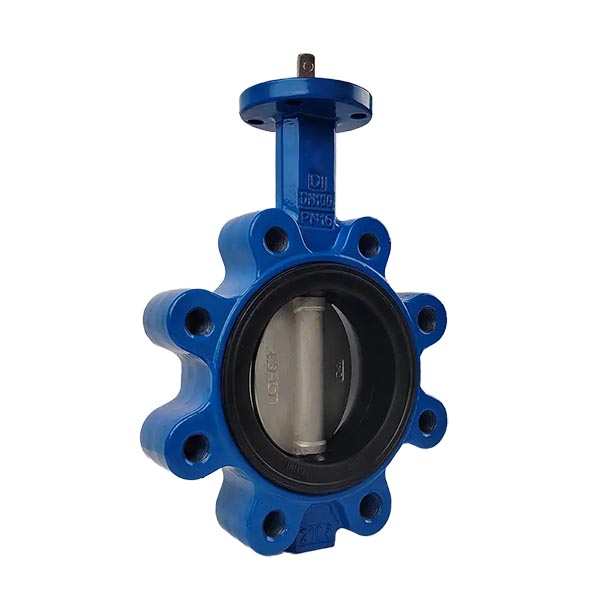
Replaceable soft valve seat, without a Hard backing plate, made of soft materials such as rubber and silicone.
Installation Method : Folded and embedded into the rear groove of the valve body.
3. Fundamental Difference Between the Two Types of Valve Seats
Both can be used as zero-leakage sealing materials, but the Hard backing part of the hard-back butterfly valve can be fixed to the valve body by bolts passing through small holes in the valve body. Therefore, when used as a pipeline end valve, the valve seat will not shift.