
What is a one-way valve?
A one-way valve, also known as a check valve or non-return valve, is named for its ability to allow a medium (liquid or gas) to flow in only one direction. It automatically prevents reverse flow. It requires no external power, relying entirely on the pressure changes of the medium itself to open and close (do not misunderstand a slow-closing check valve; its weight is not its actuator).
The principle of a one-way valve is simple: it opens when the fluid flows in the forward direction and closes when the fluid stops or flows in the reverse direction. However, behind this seemingly simple structure lies complex engineering logic, risk control considerations, and fluid dynamics principles.
A one-way valve is more than just a component; it is a “silent guardian” in fluid systems.
1. Basic Definition and Core Functions
The core functions of a one-way valve include:
* Automatically opening when the upstream pressure is greater than the downstream pressure;
* Automatically closing when the downstream pressure is greater than the upstream pressure;
* Preventing damage to equipment or systems caused by reverse flow.
Unlike gate valves and butterfly valves, check valves require no actuator, no manual operation, and no control signal. They rely entirely on differential pressure for operation.
This “passive intelligence” is precisely where their value lies.
2. Common Types of Check Valves
Check valves are widely used and indispensable:
* Water supply and drainage systems
* Oil and gas pipelines
* Chemical plants
* Heating, ventilation, and air conditioning (HVAC) systems
* Fire protection piping networks
* Compressor systems
* Medical equipment
Although their working principle is the same, their structural forms vary to adapt to different operating conditions.
2.1. Swing Check Valve
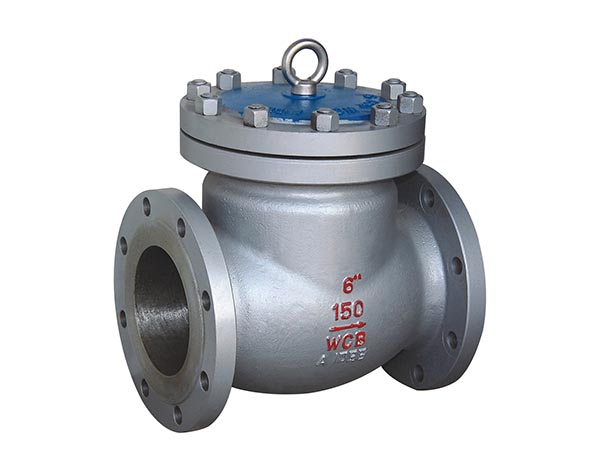
Features:
* Usually flanged connection;
* Opens and closes by the valve disc swinging around a hinge;
* Suitable for horizontal pipelines;
* Low flow resistance;
* Suitable for large-diameter systems;
Disadvantages: Relatively slow closing speed, and prone to water hammer in some systems.
2.2. Dual Plate/Wafer Check Valve
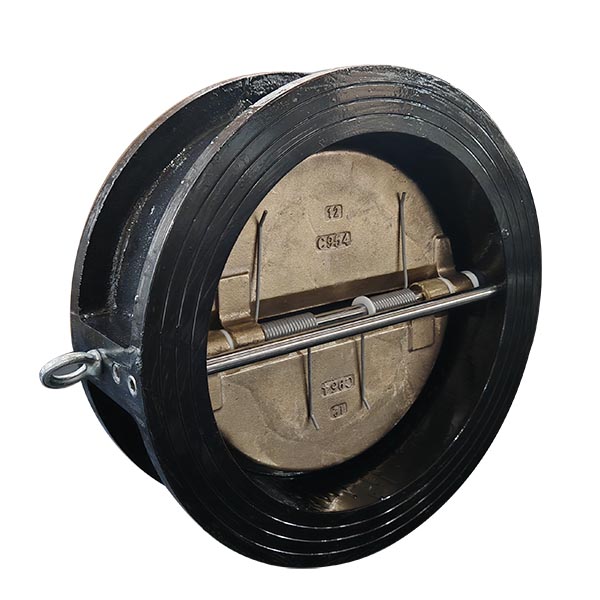
Features:
* Uses a dual-plate structure;
* Spring-assisted closing for rapid shut-off;
* Compact size and lightweight;
* Reduces water hammer;
* Suitable for space-constrained applications.
Widely used in modern compact piping systems.
2.3. Lift Check Valve
Features:
* Valve disc moves vertically;
* Good sealing performance;
* Suitable for high-pressure systems;
Commonly used in vertical pipelines.
However, fluid resistance is relatively high.
2.4. Ball Check Valve
Features:
* Uses a ball as the opening and closing element;
Suitable for sewage and media containing solid particles;
Not prone to clogging;
Simple maintenance.
Especially suitable for sewage discharge and low-maintenance environments.
3. Why is Backflow Dangerous?
A check valve essentially establishes a mechanical buffer barrier between the active equipment and the system’s inertia.
Reverse flow can lead to:
* Pump damage: Reversing the pump impeller can severely damage the mechanical structure;
* Contamination problems: Backflow of chemical media can contaminate clean pipelines;
* Pressure shock: Generating strong water hammer;
* Energy loss: Reduced system efficiency;
* Safety risks: Fire suppression systems may fail.
In high-energy systems, reverse flow is often catastrophic.
For example, pumps are designed based on hydraulic calculations and mechanical coordination in a single direction of rotation. In a centrifugal pump system, when the pump stops, liquid may flow backward if there is a height difference. Without the protection of a check valve, the pump may rotate in reverse. Once the pump rotates in reverse, it can cause a sharp drop in efficiency and increased vibration, or even damage to mechanical seals, bearing failure, or impeller breakage, potentially leading to a complete system failure.
4. Fluid Dynamics Principles
To understand this principle, we first need to emphasize these two concepts:
4.1 Opening Pressure
This refers to the minimum pressure difference required for the valve to initially open.
If too high:
* Increased energy consumption;
* Affected pump efficiency.
If too low:
* Valve disc vibration;
* Causing tremors;
* Accelerated wear.
4.2 Water Hammer
Water hammer is a pressure shock caused by the sudden cessation or reversal of fluid kinetic energy.
A check valve cannot completely eliminate water hammer; it merely redistributes the timing of the impact.
The engineering goal is not to eliminate the impact, but to control it.
4.3 Core: Mechanical Principles
A check valve operates based on a pressure difference (ΔP):
When:
ΔP = Upstream pressure − Downstream pressure > Opening pressure → Valve opens
When:
ΔP < 0 → Valve closes
However, the real engineering challenge is not “opening,” but “how to close.”
Closing speed determines:
* Water hammer strength
* Valve disc wear
* Noise level
* Service life
The following must be considered during design:
* Valve disc weight
* Spring force (e.g., double-plate check valves)
* Fluid flow rate
* Installation direction
The core design principle of a check valve is actually the control of transient flow, not just steady-state flow.
5. Common Misconceptions
* All check valves are the same – Wrong.
* Only prevents backflow – Much more than that.
* Installation direction doesn’t matter – Extremely critical.
* Cheap is fine – Can be extremely costly in high-energy systems.
6. Conclusion
A check valve is not just a backflow prevention device; it is the core of passive protection in fluid systems.
* It requires no electricity.
* It requires no control.
* It requires no operation.
* It operates solely on physical principles.
But without it, modern fluid systems would be fraught with risk and instability.
A small device, yet it bears a huge system responsibility.
Post time: Feb-23-2026